The Bible Of Affiliate Marketing

Posted August 26th, 2011. Filed under Affiliate Marketing

Super Affiliate Handbook

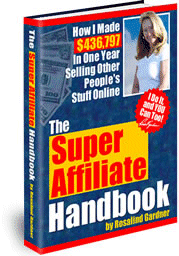
Known as the ‘bible’ of Affiliate Marketing, Rosalind Gardner’s Super Affiliate Handbook is a MUST-READ for anyone who wants to become an affiliate marketer.

In a style that is friendly and humorous, the Super Affiliate Handbook is peppered with real examples of what Rosalind did to become one of the most recognizable Super Affiliates in the world. And she doesn’t just tell you what she did right—she exposes the mistakes she made as well—to help you avoid potential problems.

Exceptionally well written, Super Affiliate Handbook covers absolutely everything you need to know about making money as an affiliate marketer. In 220+ pages, you’ll learn how to pick the best programs, negotiate a commission raise and save time, money and effort on everything from affiliate software to web hosting.

I HIGHLY Recommended it.

How To Set And Get Your Price by Bob Bly

Posted August 26th, 2011. Filed under Business

Ask most experienced direct marketers, “What’s the best price to charge for my product,” and the answer will be: whatever the market will bear.

In direct marketing, we can test prices and quickly see which is the most profitable at generating the highest return on marketing dollars (ROMD).

Surprisingly, tests show that higher prices sometimes generate more orders than lower prices.

In one classic test, a publisher was offering a loose-leaf service teaching presentation skills to business executives.

When they tested $197 vs. $297 in their advertising, $297 was the winner.

Most direct marketers conclude that you should test prices, and if the higher price wins, go with that.

While this is a sensible strategy in most instances, are there any reasons NOT to charge top dollar—or any situations in which charging a too-high price may come back to bite you—even if your price tests show the higher price is the winner?

I can think of several such situations.

The first is when pricing professional services.

GD, a pricing expert, once told me that the ideal price level for your professional services is in the middle of the top third and NOT “the most you can get”.

Let’s say the hourly rates for service providers in your industry range from $100 at the bottom to $400 at the top.

You don’t want to be in the lower third of the price range, charging $100 to $200 an hour, because prospects equate a bargain price with an inferior quality product or service.

Pricing in the middle range, at $200 to $300 an hour, isn’t bad. But it just makes you one of the herd—a commodity.

The top range is an hourly rate between $300 and $400. So by following GD’s advice, we would set our hourly rate at $350, smack dab in the middle of the upper third.

This is high enough that we are perceived as a top professional in our field, but not so high that we are always the most expensive supplier.

Well, if you are the highest-priced provider in your field out there, you will cause prospects to hesitate before hiring you.

“Every time you give your clients an estimate, they will strongly consider bidding the job out for competitive quotes rather than just signing your agreement,” said GD.

“One day soon, they will try someone else, find they get equivalent service for a lower price, and you will never hear from them again.”

Another problem with charging outrageously high prices is that it creates ill will between buyer and seller.

The buyer feels ripped off, and complains loudly about things he might otherwise let pass.

Also, if you charge a premium price and you fail to deliver the results you promised, that client will never hire you again…and will badmouth you to others.

Here’s another sign that your prices are too high: a spike in the refund rate.

So how do you put a logical limit on your pricing?

My friend, information marketing guru Fred Gleeck, has a simple rule.

“I don’t sell a product unless I truly believe that the content is worth at least 10 times the price I am charging,” he says.

Then there is the ethical question: given our free market society, is it OK for a drug company to charge a price for a proprietary medication that only the wealthiest patients can afford, especially when doing so effectively sentences poor people with the disease to death?

Fortunately, most of us don’t market products that people absolutely can’t live without, though some of us price our products as if that were the case.

However, no matter what your pricing is—high, low, or in between—rest assured that some folks will complain about it as being unfair.

Is there a way to prevent consumers from protesting against your high prices?

Yes, by offering them different options for getting your information or knowledge as follows.

>> The premium consulting service: a high level of personal service rendered by you or another top specialist and priced accordingly…in the thousands of dollars.

>> The mid-range coaching service: the customer does most of the work, but you offer advice, support, and encouragement through weekly telephone calls, online help, or some other mechanism with a service component.

>> Information products: you sell a manual, DVD, or audio learning system that teaches people how to solve the problem themselves. It’s entirely packaged, reasonably priced (in the hundreds of dollars), and involves little or no personal service or support on your part.

>> A book: a how-to e-book or traditionally published book giving advice on your topic…sells for anywhere from $10 to $50.

>> Free content: how-to information delivered at no cost via your blog, podcasts, free Webinars, e-newsletters, special reports, content-rich Web sites, or other advice you give away.

Having the low-priced options above—the inexpensive book and the free e-newsletter—makes it virtually impossible for consumers to complain that you are too expensive or unfairly priced.

You simply point out that if the prospect can’t afford your high-priced products and services, they can avail themselves of your knowledge through your books or free online content.

By doing so, you avert potential criticism of you as a greedy opportunist, and can sleep nights knowing bitter people who can’t afford your premium offers are not going around besmirching your reputation.

Or at least not doing so loudly.

Bob Bly is the author of “World’s Best Copywriting Secrets” and has written copy for more than 100 companies including IBM, Boardroom, Medical Economics and AT&T. He is the author of more than 75 books and a columnist for Target Marketing, Early To Rise and The Writer. McGraw-Hill calls him “America’s top copywriter”.